
Panel 3 | What did we miss? Guided debate
On this page, you will find (click to jump):
Recording
Biographies
Chair

Jacquelyn Burkell is a Professor in the Faculty of Information and Media Studies and Associate Vice President, Research, at the University of Western Ontario. Her research focuses on the social impact of technology, examining how technological mediation changes social interaction and information behaviour. She is a co-investigator on the Autonomy Through Cyberjustice SSHRC Partnership grant, and was also a co-investigator on the eQuality Project, a SSHRC Partnership grant focusing on youth equality and privacy online. Her current research focuses on informed consent, and she is a collaborator on a SSHRC Insight Grant focused on challenges to the individual model of consent for the release of personal information. She works collaboratively with colleagues in law, sociology, engineering, and multiple other disciplines. She thrives on the excitement and challenge of interdisciplinary research, and is particularly interested in bringing empirical work from Psychology and Sociology into dialogue with legal and policy issues, in order to inform effective and appropriate responses to some of the challenges of our changing digital environment.
PanELISTS

Catherine McKinnon obtained her LL.B. from the University of Toronto and was called to the Ontario Bar in 1994. She joined Justice Canada in 1995. Her work in areas of social policy, diversity and equality, and judicial affairs fostered an early interest in access to justice, including as lead counsel on Unified Family Court expansion and supporting the National Action Committee on Access to Justice in Civil and Family Matters. In 2019 Catherine was delighted to join the Department’s Access to Justice Secretariat. She now leads the Secretariat’s collaborative efforts to advance a people-centred approach to justice and the full realization of Sustainable Development Goal 16, with its vision of equal access to justice for all.

Giampiero Lupo is a researcher of ISASI-CNR and has previously worked and collaborated with IGSG-CNR, the University of Bologna, and the University of Siena. He received his PhD in Political Science-Comparative and European Politics from the University of Siena. Through his research and technical assistance work, he has gained over ten years of experience in the development and study of the impact of ICT technologies in judicial systems. In this field, he coordinates CNR research units in projects funded by the European Commission, such as e-CODEX (development of a European electronic platform for the exchange of legal data), IDEA (development of an AI system for the digitization of labor law procedures), and LINK (development of a blueprint for the digitization of support and protection procedures for children victims with disabilities), as well as projects funded by national funds such as SEVeso (study of protection services supporting victims of environmental crimes). He is also the principal investigator of the Meta-Just project, which studies and develops a virtual court based on the application of metaverse technologies.
In his research and technical assistance work, he has collaborated and continues to collaborate with national and international public entities such as the Italian Ministry of Justice, DGSIA (Directorate General for Automated Information Systems), various Ministries of Justice in Europe, CEPEJ (European Commission for the Efficiency of Justice), the Embassy of Canada, and the University of Montreal. He has been a member of the AIAB (Artificial Intelligence Advisory Board) established by CEPEJ to conduct consultation and research activities on AI and justice in Council of Europe countries. He is the author and co-author of more than 20 scientific publications in conferences, workshops, international journals, and books on topics related to the use and impact of ICT technologies in judicial systems, ethical issues of Artificial Intelligence, ICT and e-justice assessment tools, victims’ access to justice, and quality of justice.

Ayelet Sela is a lecturer (assistant professor) at the Faculty of Law, Bar-Ilan University, and a non-resident fellow at Stanford Law School’s Deborah L. Rhode Center on the Legal Profession. Her research focuses on dispute system design, procedural justice, and access to justice within courts, tribunals, and other dispute resolution mechanisms. Dr. Sela’s work particularly examines the impact of online and hybrid procedural frameworks, exploring how justice systems can harness technology and procedural innovations to better serve self-represented individuals and improve outcomes. As a founding member of the BIU LawData Lab, she collaborates with data scientists to apply computational methods to legal data and to evaluate the use of AI in regulatory and court-related contexts. Dr. Sela earned her JSD and JSM from Stanford Law School and her LL.B from the Hebrew University in Jerusalem.

Karine Gentelet is Full Professor of Social Sciences at the Université du Québec en Outaouais (UQO) and Scientific Director of collaborations with civil society for OBVIA (Observatoire international des impacts sociétaux de l’AI et du numérique). In 2020-2022, She was holder of the Professorship Chair on Social justice and AI Abeona-Ens-Obvia. Her research interests and publications focus on impacts of artificial intelligence technologies on social justice, civil participation and human rights, including First Peoples’, on research ethics in Indigenous context.
Summary
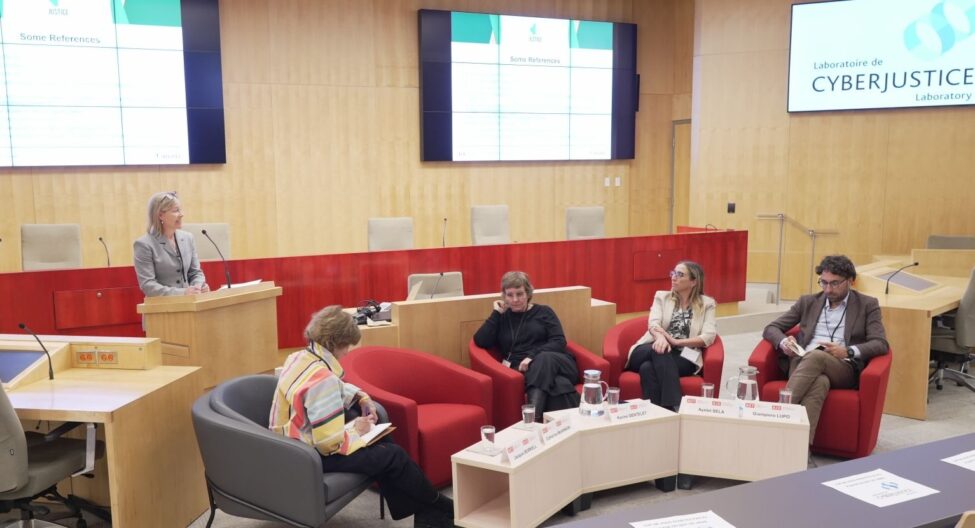
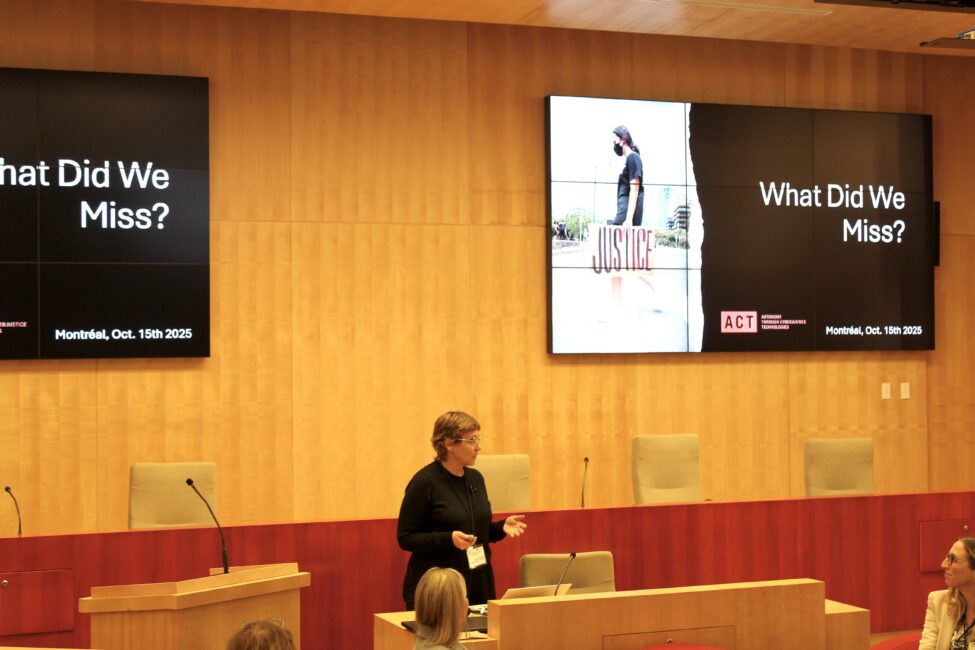
Panel Three examined what remains overlooked in the quest to make technology, especially artificial intelligence, a true instrument of access to justice. Chaired by Jacquie Burkell, the discussion brought together perspectives from government (McKinnon), academia (Sela), sociology (Gentelet), and technology design (Lupo). The participants agreed that for justice to be equitable in a digital age, it must remain people-centered and participatory.
Catherine McKinnon began by noting that Canada’s justice innovation exists alongside persistent inequality and technological exclusion. Citing data, she pointed out that while over 90 percent of Canadian households have high-speed internet, the figure in Nunavut is effectively zero. A 2025 study by KPMG and the University of Melbourne also found that Canadians rank among the lowest worldwide in AI literacy and trust. McKinnon argued these figures show that virtual hearings and digital tools are not universal remedies. They are parts of a plural system that must accommodate diverse needs. She advocated for innovation anchored in “people-centered justice”: consult affected communities about their legal problems; gather evidence on what works; equip users to assess digital tools; and foster cross-sector collaboration. Only through such participation, she argued, can technology truly provide access to justice.
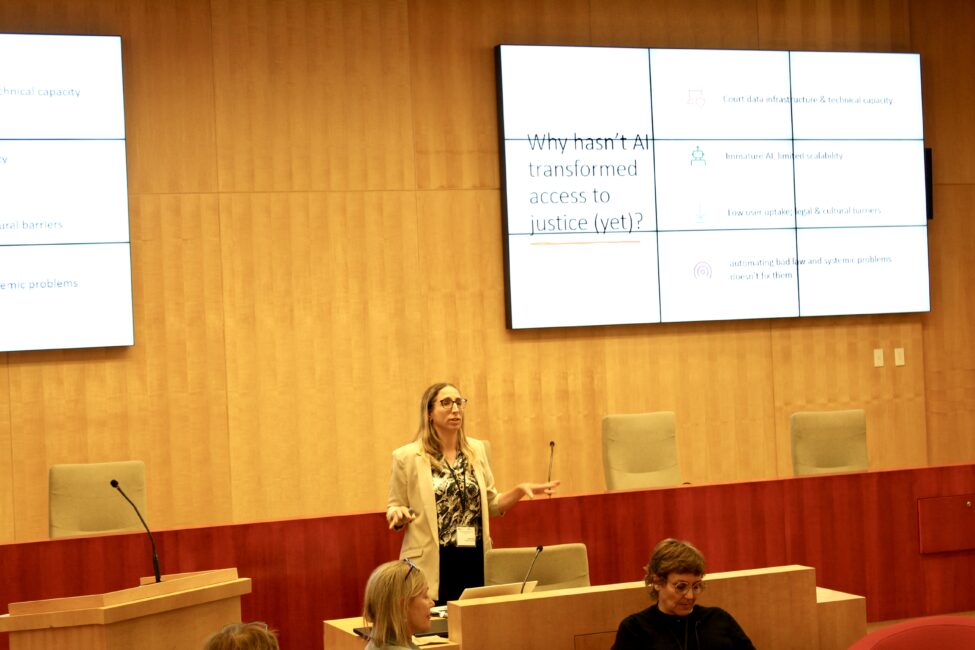
Building on this, Ayelet Sela examined why AI has not yet fulfilled its promise in courts. Using research from U.S. lower courts, including the Los Angeles Superior Court, she argued that the heart of the access-to-justice crisis lies in local venues, where most disputes occur and litigants are overwhelmingly self-represented. She identified four obstacles: First, fragmented data (incompatible court systems); second, immature tools (requiring heavy human oversight); third, limited uptake (due to design, literacy, or procedural barriers); and fourth, regulatory constraints (like the line between legal information and advice). Sela warned that “automating bad law” risks entrenching injustice. Software alone, she said, cannot solve short deadlines, high filing fees, and complex procedures. She proposed using AI to “augment” rather than “replace” human legal support; reforming rules to allow for tiered assistance; promoting data-driven court management; and redirecting innovation toward early problem prevention. Justice, she concluded, should be “reimagined,” not merely “digitized.”
Karine Gentelet offered a sociological counterpoint, presenting findings from a global qualitative study that asked citizens what “justice” means in the context of AI. Across regions, respondents equated justice with social justice: the fight against inequality, discrimination, and democratic erosion, not simply access to courts. Gentelet identified three dimensions often missing from AI-for-justice debates: First, inclusion requires understanding exclusion; digitalization can magnify existing inequities. Second, citizen engagement must be genuine. People want their lived experiences embedded in design and governance. Civil society acts as a crucial intermediary. Third, access to redress is essential when rights are harmed by AI. Gentelet called for comprehensive education in digital rights (as human rights) and for participatory mechanisms that give citizens a voice in both design and accountability.
Giampiero Lupo then illustrated how participatory research is being put into practice by the Italian National Research Council. He described several projects: LINK (helping child victims participate in criminal proceedings); SUPPORT (investigating environmental-crime victims’ access to justice); Metaverse Justice (exploring virtual courtrooms for training); and IDEA (applying AI to labor-law disputes). Lupo stressed that in all these initiatives, stakeholder participation is a core methodology, not an afterthought. It shapes both design and evaluation.
In the closing discussion, Burkell asked what holds back implementation. Sela and Gentelet argued for “institutional sandboxes” to lower the risks of experimentation. They noted that public bodies often fear imperfection, which stifles innovation. Controlled pilots, agile design, and data-driven evaluation could help overcome this. McKinnon added that transparency and education are prerequisites for restoring public trust. Lupo pointed to successful models where civil society developed tools later adopted by government. The exchange also highlighted sharp variations across jurisdictions. Stewardship, maintenance, and contextual fit emerged as decisive.
Panel Three concluded on a note of cautious optimism. The pandemic showed that courts can adapt rapidly under pressure. The next decade will test whether they can adapt deliberately and equitably. AI may transform justice only if justice itself remains contestable, participatory, and grounded in human experience. As Burkell summarized, the challenge is not simply to automate procedures; it is to ensure the institutions deploying these tools are worthy of the trust they demand.
Summary written by Jinzhe Tan.
Photos
This content has been updated on 21 November 2025 at 10 h 12 min.